First Published in Bangkok Post on Wednesday, May 10, 2023
As election campaigns are heating up, political parties are fiercely competing to win votes by offering generous cash handouts, raising concerns about their impacts on the country’s fiscal discipline for the incoming administration.
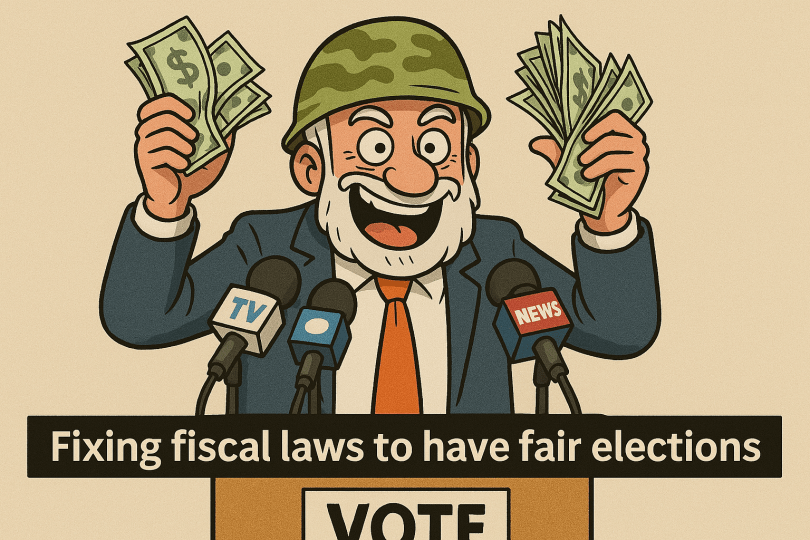
It is a legitimate concern. Yet the focus on the post-election financial burden should not overshadow the outgoing administration’s last-minute budget spending for political gains, which also endangers fiscal discipline.
The 2018 State Fiscal and Financial Act mandates that the government exercise strict fiscal restraint and forbids it from pursuing political popularity at the expense of the nation’s long-term interests. This law also establishes fiscal rules and regulations on how the government must manage state income and expenditures while imposing a limit on the accumulation of public debt.
Yet, legal loopholes can be exploited during an election period. In order to advance their political agendas, departing administrations may decide to forego transparency by going on a spending binge right before leaving office, which is a flagrant breach of fiscal responsibility.
Such spending for political gains includes the government’s approval towards the end of its rule to increase the salaries of certain groups of officials to win their support at the polls.
Just one week before the Parliament was dissolved on March 20, the cabinet approved raising the annual salaries of 5,300 subdistrict administrative organizations, or Or Bor Tor, across the nation to 13,744.69 million baht. This represents an increase of 44.66% or 4,252 million baht over the previous salary base.
The very same day, the cabinet approved the salary increase of sub-district heads or kamnan from 10,000 to 12,000 baht, the village heads from 8,000 to 10,000 baht, and sub-district health officials from 6,000 to 7,000 baht.
A week earlier, the cabinet had approved monthly financial support for village health volunteers across the country from 1,000 to 2,000 baht. Notably, their pay was increased by the previous administration from 600 to 1,000 baht, also just before the election.
In addition to salary increases for the groups of officials who could act as voting bases, another strategy is to approve projects to garner public support through quasi-fiscal channels.
This is accomplished through the cabinet’s approval for state loans from the government’s specialised financial institutions like the Government Savings Banks or the Bank for Agricultural and Agricultural Cooperatives (BAAC). According to the loan agreements, these banks will finance specific government initiatives, and the succeeding administration will repay the loans from the national coffer.
A recent example is the Prayut administration’s approval of the One Million Cows Project, which is being managed by the National Village and Urban Community Fund Office through loans from the Bank for Agricultural and Agricultural Cooperatives. Under this four-year project, the village fund office will lend money to farming families so they can each purchase two cows, and the following administration will repay the bank for the loans.
The outgoing government may have the best of intentions, but these policies are tied to future national budget spending. The government must, therefore, uphold fiscal responsibility and transparency by outlining the expenditure in detail and indicating how it will affect the budget of the administration that comes after. In addition, using the budget in this manner may create political popularity that surpasses the opponent, which should not come from using the state budget.
Despite the law on fiscal discipline, it does not cover how the government uses national budgets when elections are imminent. The election law and regulations also contain no restrictions on the use of the national budget to sway elections.
To close these legal loopholes, a system of oversight for the final budgetary expenditures of the departing government must be added to the current law on fiscal discipline. This system is also crucial to ensure a fair election and prevent the government from abusing its authority against the opposition and smaller political parties.
Such a budgetary oversight system to guarantee fiscal discipline and fair elections is not uncommon in other countries.
For example, in Australia, the Charter of Budget Honesty Law mandates that the government publish an economic and financial report within 10 days of the election’s date being set.
The government has a responsibility to inform the populace of the economic and financial situation before an election. The report includes the amount of public debt, long-term fiscal liabilities, and budgetary spending. The report’s objective is to provide information to assist voters in their voting decisions.
Meanwhile, in Brazil, raising the pay of public employees during one’s final year in office or the parliament is regarded as a fiscal crime.
Thailand should consider Australia’s model. The economic and financial report on the country’s situation is important for the government’s transparency and credibility. Public access to information also strengthens the democratic process.
The Brazil model, however, is complicated legally and difficult to find solid proof, which ultimately renders the legal efforts futile.
At present, Thailand does not have a strong and independent state agency to monitor the repercussions of the government’s fiscal policies like the Congressional Budget Office in the United States. Given the widespread criticism of the so-called “independent” constitutional organizations at the moment, however, it is not a smart idea to create yet another independent state organisation to carry out this oversight function.
Instead, a viable alternative is to support civil society and academia to monitor and evaluate government spending. However, to effectively close the legal loopholes in the fiscal discipline law, an elected government should set up a legislative budget office once it assumes office.
Otherwise, any administration will be able to continue using taxpayer money improperly by going on last-minute spending sprees to sway voters’ ballot decisions.
Fiscal discipline is not the only issue at hand. A free and fair election is crucial to democracy. To safeguard the country’s fiscal integrity and democratic values, this political abuse of the national coffer must end.
 Khemmapat Trisadikoon